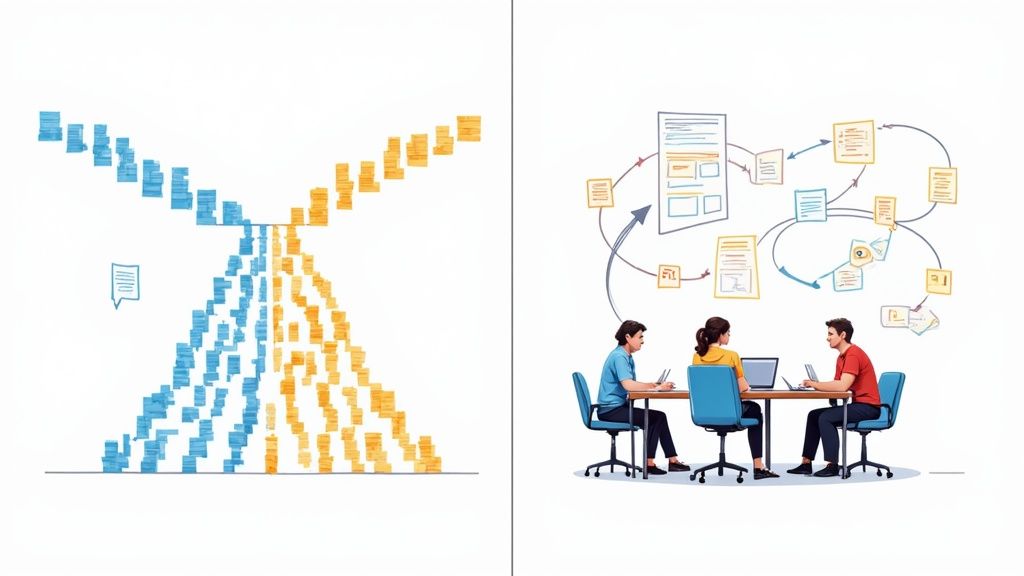
Agile vs Waterfall Methodology A Practical Guide
At its heart, the difference between Agile and Waterfall comes down to this: Agile is a flexible, iterative approach made for projects where the requirements are likely to change. Waterfall, on the other hand, is a linear, step-by-step method designed for projects where the scope is fixed and predictable from the get-go.
Making the right choice here isn't just an academic exercise - it directly shapes your budget, timeline, team collaboration, and the quality of the final product.
Choosing The Right Project Management Approach
Picking the right methodology is one of the most important calls a project manager has to make. There's no single "best" answer; it’s all about finding the perfect fit for your specific project, your team's way of working, and what your client actually expects. Forget the textbook definitions for a moment - this is about practical, real-world guidance.
The decision often hinges on one simple question: do you know exactly what you need to build from day one? This decision tree lays out that fundamental starting point perfectly.
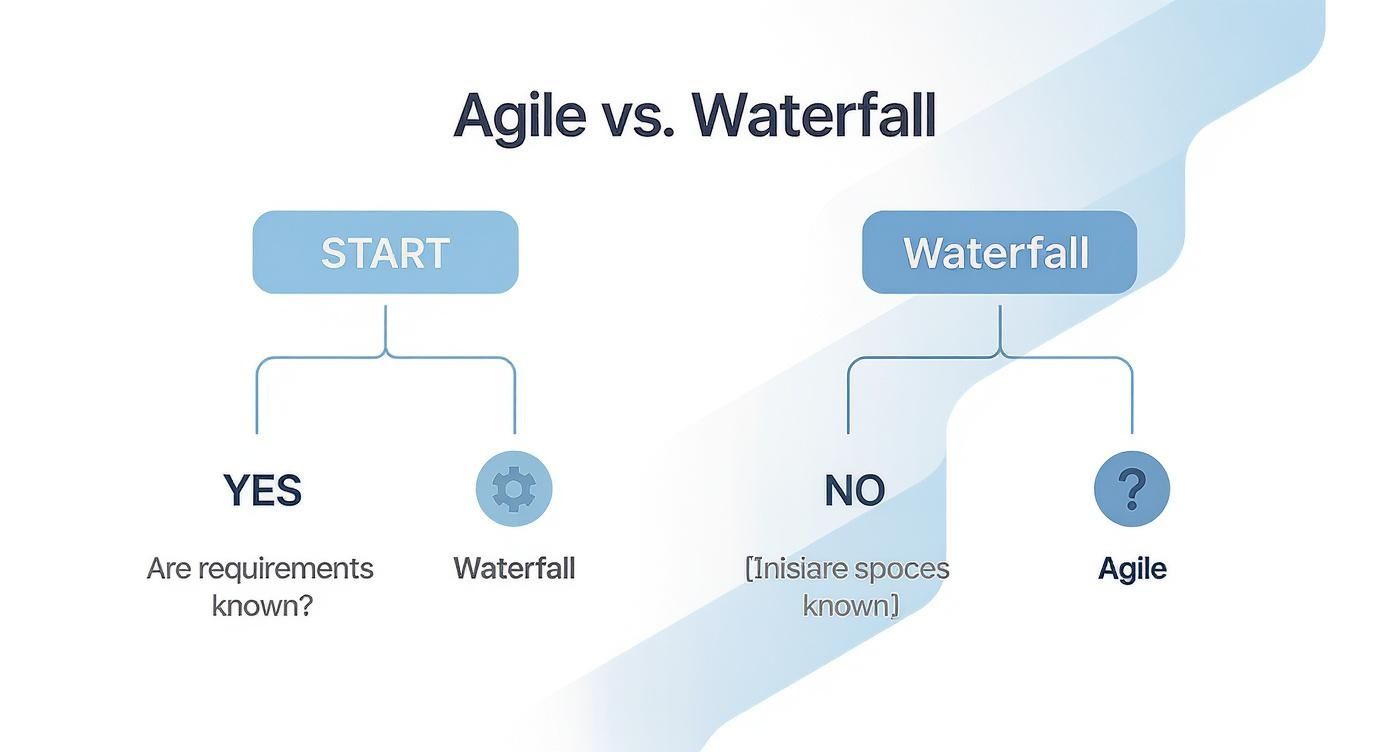
As you can see, if you have a rock-solid, fixed scope, you're naturally leaning toward Waterfall. If things are a bit fuzzy or expected to evolve, Agile's adaptive nature is probably your best bet.
Agile vs Waterfall at a Glance
To quickly grasp the core differences, this table offers a high-level snapshot of how each approach handles the key moving parts of a project.
No matter if you're a freelancer or running a small business, getting this choice right is crucial. The right tools can make all the difference, too. You can explore our guide on the best project management software for small businesses to see how platforms like Notion, powered up with Widgetly, can support either workflow seamlessly.
| Characteristic | Agile Methodology | Waterfall Methodology |
|---|---|---|
| Project Flow | Iterative and cyclical; the project is built in small, repeating sprints. | Linear and sequential; one phase must be completed before the next begins. |
| Flexibility | High; changes are welcomed at any stage to improve the final product. | Low; changes after the initial planning phase are difficult and costly. |
| Customer Involvement | High and continuous; feedback is gathered after each sprint. | Low; involvement is primarily at the start (requirements) and end (delivery). |
| Documentation | Minimal; focuses on a working product over comprehensive paperwork. | Extensive; detailed documentation is created and approved for every phase. |
This table lays out the foundational distinctions, but the real magic is in understanding the nuances of when and where to apply each method.
Understanding the Waterfall Methodology
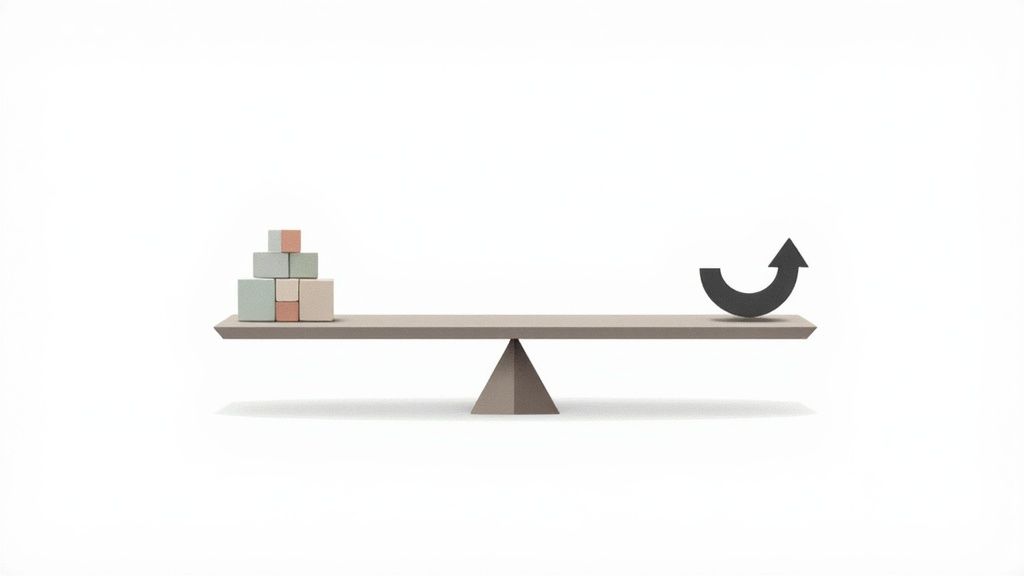
The Waterfall methodology is the old-school, traditional approach to managing projects. The name says it all - it’s a linear, step-by-step process where progress flows downward through distinct phases, just like a real waterfall. You have to finish one stage completely before you can even think about starting the next.
Imagine you're building a house. You lay the foundation first (requirements), then you put up the frame (design), build the walls (implementation), and finally, you inspect the whole thing (verification). You can't put the roof on before the walls are up, right? That top-down, rigid structure is the heart and soul of the Waterfall model, and its emphasis on control and predictability is why it was the go-to standard for decades.
The Phases of Waterfall
What really defines Waterfall is its strict sequence. The names of the stages can differ a bit from team to team, but the general flow is always the same:
- Requirements: At the very start, every single project requirement is gathered, analyzed, and documented down to the last detail. This phase locks in the full scope of the project.
- System Design: With the requirements approved, the team designs the system’s architecture, figuring out all the hardware and software needed.
- Implementation: This is where the coders and developers get to work, building the product based on the design documents.
- Testing and Verification: Once the build is complete, the QA team jumps in to test the entire product from top to bottom, hunting for bugs to fix.
- Deployment: After the product passes all the tests, it’s finally released to the client or launched to the public.
- Maintenance: The project isn't over at launch. This phase involves ongoing support and updates to handle any issues that pop up later.
Philosophy and Core Principles
The entire philosophy behind Waterfall is built on one core idea: you can plan a project perfectly from the very beginning. This makes it an incredibly solid choice for projects where the requirements are set in stone and everyone knows exactly what needs to be built.
Historically, Waterfall was the king of software and project management through the late 20th century. However, since the early 2000s, Agile approaches have steadily taken its place. Waterfall's rigid, phase-based process demands extensive upfront planning, which doesn't mesh well with today's fast-paced business world where requirements can change on a dime. You can learn more about how project mindsets have shifted on adevait.com.
The fundamental belief of the Waterfall model is that investing heavily in upfront planning and documentation minimizes risk and ensures a predictable outcome. Change is viewed as a source of error, not an opportunity.
This intense focus on detailed documentation and a strict structure gives everyone involved a clear roadmap. It makes it much easier to track progress against the original plan and keep the budget under control.
Exploring the Agile Methodology
Think of Agile not just as a process, but as a complete shift in how to approach a project. It was born out of frustration with the old, rigid methods like Waterfall. Instead of one long, linear march to a finish line, Agile breaks everything down into smaller, bite-sized cycles called sprints.
The whole idea is to build, test, and release small, working parts of the project continuously. This means you don't have to wait until the very end for a "big bang" launch. It's all about collaboration and adapting on the fly. Change isn't the enemy; it's a welcome opportunity to make the final product better based on real-world feedback. This makes it perfect for those complex projects where you don't have all the answers upfront.
Core Principles and Popular Frameworks
At its heart, Agile is a mindset guided by flexibility and a constant drive to improve. This philosophy comes to life through different frameworks, but two of them - Scrum and Kanban - are by far the most popular.
- Scrum: This is a very structured way of doing things. Work is organized into sprints of a fixed length, usually two to four weeks. You have defined roles like a Product Owner and a Scrum Master, and set meetings like daily stand-ups to keep everyone in sync.
- Kanban: This one is much more fluid. It’s all about visualizing your workflow on a board and managing how much work is in progress at any one time. Teams just pull the next task when they have the capacity, which is great for managing continuous delivery or projects where priorities are always shifting.
This is a great visual of a standard Scrum workflow. It really shows how each sprint cycles from the backlog to a piece of a working product.
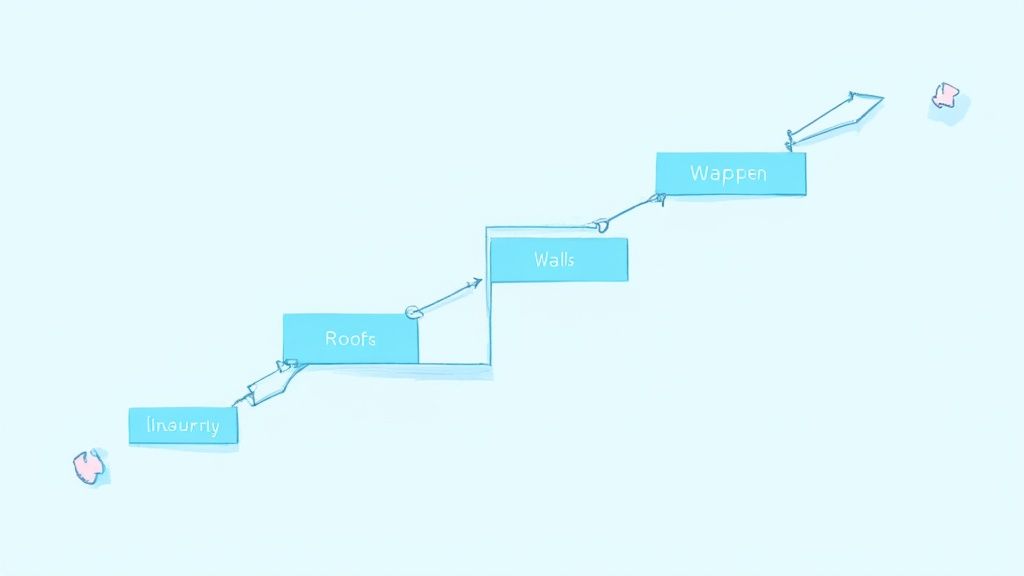
As you can see, each sprint delivers something functional that can be reviewed and adjusted, keeping the project on track and relevant.
This adaptive style is why it has taken over the industry. Today, over 70% of businesses around the world have adopted Agile practices. And within that group, Scrum is the clear favorite, used by about 66% of Agile teams. It’s especially dominant in fast-paced industries like tech, finance, and healthcare, where the ability to pivot is what separates success from failure. You can find more details on how companies are using Agile at TechDataPark.com.
The biggest difference with Agile is the shift in focus. It's less about sticking to a rigid plan and more about dynamically steering toward a goal. It gives teams the power to react to what's happening in the real world, ensuring the final product isn't just what you planned, but what people actually need.
A Detailed Comparison of Core Differences
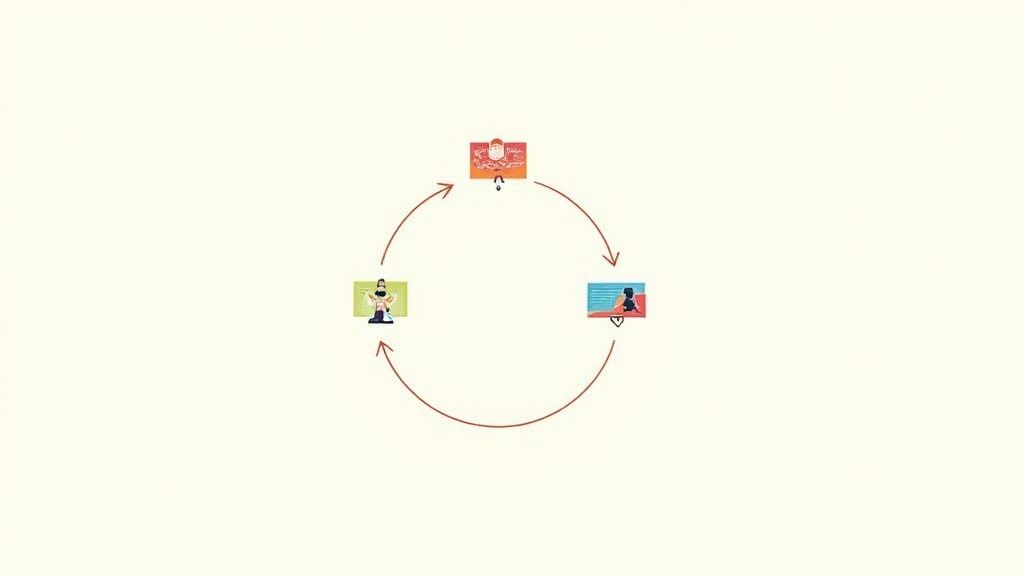
To really grasp the Agile vs. Waterfall debate, we need to move past simple pros and cons. The true test is how each methodology performs under the pressure of a real project. Your best choice always comes down to context, so let’s dig into how they stack up across four critical areas: flexibility, customer involvement, documentation, and risk management.
How each framework handles these areas is fundamentally different, and those differences will make or break your project's outcome.
Flexibility and Handling Change
The ability to handle change is probably the biggest single difference between these two. The Waterfall model is rigid by design. Its linear, sequential nature means that change is treated like a wrench in the gears. Once you’ve finished a phase and moved on, going back to tweak something is a nightmare - it’s costly, slow, and throws the whole timeline off.
Agile, on the other hand, was born to embrace change. It works in short cycles, or "sprints," which gives teams a natural pause to adjust priorities, react to feedback, and add new requirements. This built-in adaptability makes it a much better fit for projects where you don’t have all the answers upfront.
In Waterfall, unexpected changes are treated as scope creep that disrupts the plan. In Agile, changes are seen as opportunities to deliver a better, more relevant final product.
Customer Involvement and Feedback
The customer’s role is another night-and-day difference. In a Waterfall project, you’ll see heavy customer involvement at the very beginning for requirements and at the very end for final sign-off. In between? Not so much. This creates a huge risk that the final product misses the mark because needs and ideas inevitably evolve.
Agile, however, is built on constant collaboration. Stakeholders are right there in the mix, giving feedback after each and every sprint. This keeps the project perfectly aligned with their vision and all but eliminates those dreaded end-of-project surprises. This collaborative approach clearly works; Agile adoption in software development shot up from 37% to 86% between 2020 and 2021. You can find more details about these agile statistics on Parabol.co.
Documentation Approach
The two methodologies couldn't be more different when it comes to paperwork. Waterfall is documentation-heavy. It demands exhaustive plans, specs, and design documents be created and signed off before a single line of code is written. This leaves a thorough paper trail but can also bring progress to a grinding halt.
Agile takes a much leaner stance, believing a working product is more valuable than a mountain of documents. Documentation still happens, of course, but it’s kept practical and to the point - just enough to get the job done and keep everyone moving forward.
Risk Management Strategy
Finally, let’s talk about how they handle risk. Waterfall tries to map out every conceivable risk during the initial planning phase. It’s a noble effort, but let's be realistic - unforeseen problems are a guarantee. When those issues pop up, the model’s rigidity makes it incredibly difficult to pivot effectively.
Agile deals with risk iteratively. By slicing the project into small, manageable chunks, teams can spot and squash problems almost as they happen. This approach keeps small issues from snowballing into project-killers. Looking at some real-world project risk management examples can help show you how these strategies play out in practice.
Now, let's lay these differences out side-by-side for a clearer picture.
Feature-by-Feature Methodology Breakdown
This table breaks down the core philosophies of Agile and Waterfall across key project dimensions, giving you a quick reference for their distinct approaches.
| Dimension | Agile Approach | Waterfall Approach |
|---|---|---|
| Flexibility | High. Built to welcome and adapt to change at any stage. | Low. Change is disruptive and costly once a phase is complete. |
| Customer Involvement | High and continuous. Feedback is integrated throughout the lifecycle. | Low. Concentrated at the beginning (requirements) and end (delivery). |
| Pacing | Iterative and fast-paced, with short work cycles (sprints). | Sequential and deliberate, with one phase completed before the next. |
| Planning | Adaptive. High-level plan exists, but details emerge over time. | Predictive. All requirements and plans are defined upfront. |
| Documentation | Lean and functional. "Just enough" to support the work. | Comprehensive and formal. Heavily documented at every stage. |
| Risk Management | Iterative. Risks are identified and mitigated within each sprint. | Upfront. All potential risks are identified and planned for initially. |
| Testing | Continuous. Testing is done concurrently with development in each cycle. | Phased. A dedicated testing phase occurs after development is complete. |
| Delivery | Incremental. A working version of the product is delivered after each sprint. | Big Bang. The final product is delivered in one go at the end. |
Seeing it all laid out like this really highlights the fundamental philosophical split. Agile is about adapting and learning as you go, while Waterfall is about planning meticulously and executing that plan perfectly.
When Waterfall Makes More Sense Than Agile
It’s easy to think of Agile as the modern, superior way to manage projects, but that's not the whole story. The Agile vs. Waterfall methodology debate isn't about old vs. new; it's about fit. Sometimes, the structured, predictable nature of Waterfall isn't a drawback - it's exactly what a project needs to succeed.
Waterfall shines when you know exactly what you're building from day one. If the project requirements are rock-solid, fully understood, and not expected to change, Waterfall provides a clear, reliable path forward. This is especially true for projects with heavy regulatory oversight or compliance standards, where detailed upfront documentation isn't just a good idea, it's a requirement.
Predictability is King in Stable Environments
Think about projects where surprises are the enemy. In highly regulated or physically dependent industries, Waterfall is often the go-to approach for good reason.
- Government Contracts: These jobs almost always demand exhaustive upfront planning, fixed budgets, and mountains of documentation to satisfy legal and contractual terms.
- Construction: You can't just decide to add a basement after the walls are up. Building projects have a fixed, logical sequence that Waterfall’s step-by-step phases mirror perfectly.
- Manufacturing: Setting up a new assembly line involves a precise, sequential process. Making changes halfway through can be incredibly costly and disruptive, so getting the plan right from the start is critical.
In these fields, stakeholders aren't looking for flexibility; they're looking for predictable timelines and budgets. The biggest risk isn't that the market will shift, but that the team will deviate from a carefully constructed plan.
Waterfall’s real strength is managing complexity with a ton of structure. When the finish line is fixed and the path is clear, its linear approach is the best way to minimize risk and make sure every single requirement is checked off the list.
Ultimately, picking Waterfall is a strategic call based on the need for stability. If your project has zero ambiguity, a locked-in scope, and operates in a world where predictability is the most important thing, then this classic method isn't just an option - it’s the most sensible and effective choice you can make.
When to Choose Agile Over Waterfall
In the great Agile vs. Waterfall methodology debate, your decision often boils down to a single question: How much do you really know upfront? If your project's final destination is a bit fuzzy, Agile is your best bet. It’s built for navigating uncertainty and shines when a project needs to adapt and learn as it goes.
This is especially true when you're breaking new ground - think developing a brand-new app, building a novel piece of software, or diving into a complex research project. The requirements in these situations are almost never set in stone. Market feedback is everything, and Agile’s iterative cycles are designed to embrace that reality.
Thriving on Feedback and Iteration
Agile’s magic lies in its ability to chop up huge, daunting goals into small, manageable sprints. At the end of each cycle, you have a small but functional piece of the product ready for users and stakeholders to see and touch.
This constant feedback loop is Agile's greatest strength. It gives teams the power to:
- Rapidly Prototype: You can build and test ideas fast without locking into a massive, long-term development plan.
- Integrate User Feedback: Adjustments are made based on what real people actually want, not just what the initial plan assumed they wanted.
- Pivot Based on Market Response: If early assumptions turn out to be wrong, the team can change direction quickly, saving a ton of time and money.
Of course, keeping everyone in the loop during this fast-paced process is crucial. Having a solid system for this is a must, and our guide on creating a stakeholder communication plan template offers a great starting point for structuring those conversations.
Agile is the way to go when your goal is to discover the best solution through experimentation, not just execute a perfectly detailed plan. It values customer collaboration and responding to change far more than sticking to the original script.
Bottom line: if your project is full of unknowns, requires constant input from key people, and would benefit from delivering value in small, frequent chunks, Agile is the clear winner. It gives you the flexibility to handle ambiguity and build something that truly hits the mark with your audience, making it the standard for most modern software and innovation-driven projects.
Frequently Asked Questions
When you're in the trenches deciding between Agile and Waterfall, a lot of practical questions pop up. Here are some straightforward answers to the questions I hear most often from teams trying to find the right fit.
Can You Use a Hybrid of Agile and Waterfall?
You bet. A hybrid model - sometimes called "Wagile" - is actually pretty common. It's a way of cherry-picking the best parts of both worlds: the solid, upfront planning of Waterfall and the nimble, iterative cycles of Agile.
Think of it this way: a team might use Waterfall for the big-picture stuff at the start, like nailing down core requirements and high-level system design. Once they have a solid foundation, they can switch to Agile sprints to actually build, test, and tweak the features. You see this a lot in big companies where some parts of a project are set in stone, but others need room to breathe. The trick is managing it carefully, so you don't just end up with the downsides of both.
Which Methodology Is Better for a Small Team?
Nine times out of ten, Agile is the way to go for small, tight-knit teams. The whole philosophy of Agile - close collaboration, direct communication, and letting the team organize itself - just clicks in a smaller setting.
Frameworks like Scrum or Kanban are lightweight and let small teams pivot quickly without getting bogged down. Waterfall, with all its heavy documentation and rigid phases, can feel like running in mud for a small group. Agile keeps a small team light on its feet, which is exactly what you need when you don't have a massive crew to back you up.
A small team's superpower is its ability to react fast. Agile gives them the structure to do just that, whereas Waterfall can sometimes get in the way.
How Do You Transition a Team from Waterfall to Agile?
Moving from Waterfall to Agile is a huge cultural shift, not just a simple process swap. If you want it to stick, you have to be intentional about it.
Here are the steps that really matter:
- Get leadership on board: The change needs champions at the top who will provide air cover and resources.
- Train everyone properly: Your team needs to learn more than just the ceremonies, like daily stand-ups. They need to understand the why behind Agile - the mindset of collaboration and continuous improvement.
- Start with a pilot project: Don't try to change everything at once. Pick a single, lower-risk project to test the waters and work out the kinks in a safe space.
- Bring in an expert: Designate a Scrum Master or hire an Agile coach who can guide the team, answer questions, and clear roadblocks.
At the end of the day, this is a journey. It’s about shifting from a culture that’s all about following a rigid plan to one that’s focused on delivering real value and seeing change as an opportunity, not a problem.