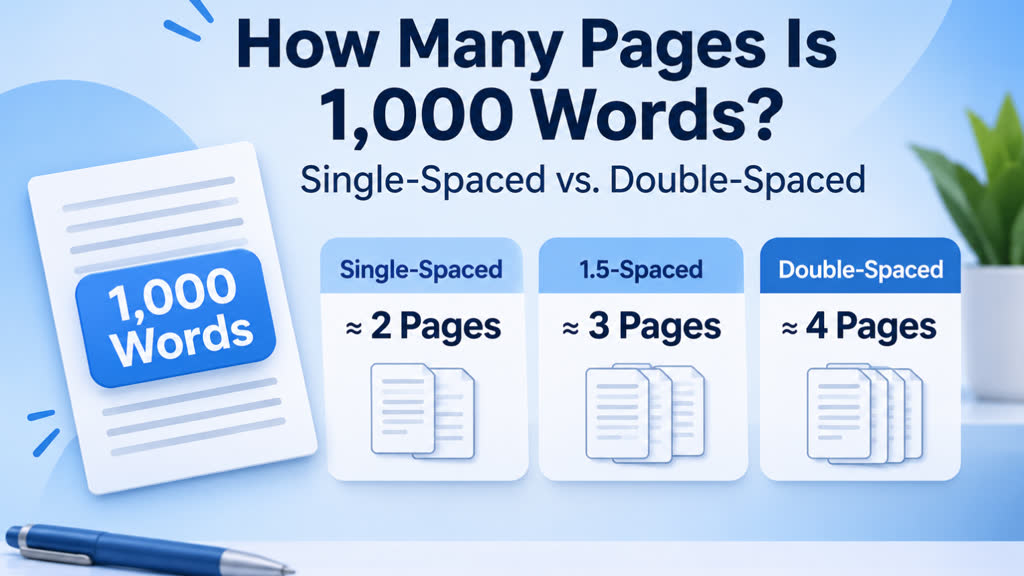
You have a 1,000-word essay to write. But what does that word count look like once it is on the page? It could be a short two-page document or something closer to four pages, depending on how you format it.
For a typical document with 12-point Times New Roman and 1-inch margins, 1,000 words will fill roughly two pages with single spacing and four with double spacing. A 1.5-spaced version usually falls somewhere in between. If you are working backward from a page requirement, a words to pages converter can give you a useful starting estimate.
How Many Pages Does 1,000 Words Take?
Here is how the same amount of writing typically looks under three common spacing settings:
| Document settings | Approximate length |
|---|---|
| Single spacing, 12 pt | 2 pages |
| 1.5 line spacing, 12 pt | 3 pages |
| Double spacing, 12 pt | 4 pages |
Think of these numbers as a guide. A page with several short paragraphs and section headings will hold less text than one filled with longer paragraphs. The font also matters. The margins and any additional formatting.
What Does a 1,000-Word Double-Spaced Essay Look Like?
For many college assignments, double spacing is the expected format. At 12-point Times New Roman with 1-inch margins, 1,000 words will generally take up about four pages.
There is a practical reason this layout appears so often in academic writing. The extra space makes it easier to read a draft. You can leave comments, and mark suggested changes. It is particularly useful when an instructor needs to review an essay or research paper.
First of all check the assignment instructions. A typical setup:
- Font: Times New Roman
- Size: 12 pt
- Line spacing: Double
- Margins: 1 inch on every side
These settings are common. They are not universal. APA-style assignments have specific formatting requirements. It should be checked against the relevant edition and your instructor's directions.
What If the Document Is Single-Spaced?
Switching to single spacing makes a noticeable difference. The same 1k words will fit into approximately two pages rather than four.
You may encounter this layout in business reports. Can be workplace documents, personal writing, and assignments where single spacing is allowed. It keeps the document more compact, although it leaves less room for handwritten comments.
One detail is easy to overlook: page count and word count measure different things. Changing the spacing does not remove or add words. It simply changes how much room those words occupy.
Why Can Two 1000-Word Documents Have Different Page Counts?
Imagine two students submit essays with exactly the same number of words. One document has four pages, while the other has five. Neither necessarily has more content. Their formatting may simply be different.
A few details can explain the difference.
Font choice and size. Times New Roman, Arial, and Calibri do not occupy exactly the same amount of space. Even when set to 12 points, their characters have different widths. A larger font will generally push the text onto more pages.
Line spacing. This is usually the most visible difference. Double spacing uses considerably more vertical space than single spacing, so fewer lines fit on each page.
Margins. Wider margins leave a smaller area for text. If your document uses margins larger than 1 inch, expect the page count to increase.
Paragraph layout. Headings, lists, quotations, and extra paragraph spacing all take up room. This is why an essay with several short sections may run longer than a continuous block of prose containing the same number of words.
How Can You Estimate the Page Count Before Writing?
A rough calculation can help when you are planning an assignment. Divide the total word count by the approximate number of words that fit on one page in your chosen format.
For example, if your double-spaced document holds around 250 words per page:
1,000 ÷ 250 = approximately 4 pages.
The 250-word figure is only a working estimate. Your actual result may differ depending on the font, margins, and paragraph layout. For a closer estimate, open a blank document, apply the required settings, and use it as a template for your draft.
How Much Time Should You Set Aside for 1,000 Words?
A 1000-word personal response and a 1000-word research essay are very different tasks. The first may involve little more than organizing your thoughts and writing them down. The second can require source searches, note-taking, citations, and several rounds of editing.
When planning your time, consider the stages separately:
- Preparation: Read the prompt and decide what you want to argue.
- Research: Gather sources and identify evidence that supports your points.
- Drafting: Write the main sections before worrying too much about perfect wording.
- Review: Check whether the argument makes sense, references are accurate, and the instructions have been followed.
Leaving revision until the last minute is a common planning mistake. A draft may reach 1,000 words quickly, but that does not mean it is ready to submit.
Checking Word Count and Page Count in Word and Google Docs
You can check both measurements without using a separate calculator.
In Microsoft Word, open the Review tab and select Word Count. The page total is also available in the document's status bar.
In Google Docs, go to Tools and choose Word count. The window displays the document's word and page totals.
Check the assignment requirements before relying on either number. Some instructors count the main text only, while others specify whether the title page, reference list, or appendices should be included.
Is 1000 Words a Lot of Writing?
Not necessarily. In a standard double-spaced academic format, it is usually around four pages, which is a manageable length for a short essay or focused response. Single spacing brings that down to about two pages.
The more useful question is whether the word count gives you enough room to address the assignment properly. Plan around the required format, leave space for revision, and focus on developing your ideas rather than trying to reach a page total through formatting alone.