
Resource Allocation in Project Management Explained
Resource allocation is the secret ingredient in successful project management. It’s the art of strategically assigning all your available assets - from people and budget to tools and time - to get a project across the finish line efficiently.
Think of it like a chef meticulously planning every single ingredient, pan, and kitchen assistant needed to prepare a perfect, Michelin-star meal. Everything has its place and its purpose. Getting this part right is the bedrock of any successful project.
What Is Resource Allocation Anyway?

Let's break it down without the corporate-speak. At its heart, resource allocation in project management is all about making smart, deliberate choices. It's the process of making sure the right resources are lined up for the right tasks at exactly the right moment.
When people hear "resources," their minds usually jump straight to team members. And while your people are absolutely your most critical asset, the term actually covers a much broader playing field. It’s about managing not just your team, but also their most precious commodity: their time. It also means spreading the project budget across different phases and making sure everyone has the tools they need to do their job, from software licenses to specialized equipment.
The Full Spectrum of Project Resources
To get a real handle on resource allocation, you have to look beyond a simple list of employees. A great project manager knows how to account for every single piece of the puzzle that contributes to the final outcome. Each type of resource brings its own challenges and needs to be managed in a specific way.
Here’s a quick breakdown of the different types of resources you'll need to juggle.
| The Full Spectrum of Project Resources | | :--- | :--- | :--- | | Resource Type | What It Covers | Real-World Example | | Human | The skills, time, and effort of your team members, freelancers, and contractors. | Assigning a senior developer to a complex coding task. | | Financial | The project budget, funding sources, and any cash reserves. | Earmarking $10,000 for the user testing phase. | | Technological | Software, hardware, cloud services, and digital tools needed for work. | Ensuring the design team has active licenses for their creative suite. | | Physical | Tangible assets like office space, machinery, or materials. | Booking a specific lab for product testing for three days. |
Understanding these categories helps you think more holistically about what your project truly needs to succeed.
More Than Just a Checklist
Treating resource allocation like a simple administrative task is one of the biggest mistakes you can make. It's actually the strategic backbone that prevents common project headaches - like team burnout, spiraling costs, and missed deadlines - before they even start.
If you don't have a solid plan, you're practically asking for trouble.
The consequences of getting it wrong are very real. In fact, sloppy resource management is a major reason why projects fail. Studies show that less than 60% of projects actually meet their original budgets, and barely 50% are completed on time. As you can learn from data provided by Retain International, these issues often trace back to poor planning.
Why Resource Allocation Can Make or Break Your Project
Let's be honest: resource allocation often gets treated like a boring administrative task. It's just moving names around on a spreadsheet, right? Wrong. Think of it as the strategic heart of your project. Get it right, and you create a smooth, efficient machine. Get it wrong, and you've got a recipe for chaos.
Poor planning isn't just a minor hiccup; it creates a domino effect. Deadlines get missed, budgets spiral out of control, and your team gets completely burned out. The line between a celebrated success and a frustrating failure is often drawn right at how well you planned your resources from the start.
It Protects Your Most Valuable Asset: Your Team
Before we even talk about money or deadlines, let's talk about people. Unbalanced workloads and unrealistic expectations are the fastest way to demotivate a team. When people are stretched too thin, burnout isn't just a risk - it's an inevitability. And burnout doesn't just hurt morale; it crushes the quality of the work.
A well-allocated team, on the other hand, is a productive and happy one. When people are given tasks that fit their skills and capacity, they feel a sense of ownership and purpose. This creates an environment where creativity thrives and people feel valued, not just used.
A team that feels supported by a realistic plan is a team that will go the extra mile. Resource allocation is the clearest signal you can send that you respect their time, skills, and well-being.
By creating balanced workloads, you're building a more resilient team. Your people will have the mental breathing room they need to tackle tough problems and handle unexpected curveballs. This isn't just good management; it's the foundation of a high-performing project team.
It Safeguards Your Budget and Timeline
Few things kill a project's credibility faster than blown budgets and missed deadlines. And more often than not, the root cause is poor resource allocation. When you have the wrong person on a task or your key expert is double-booked, you create bottlenecks that grind everything to a halt.
These delays aren't just annoying - they're expensive. Every day a project runs late can translate to higher labor costs, potential penalties, and missed opportunities. Smart resource allocation is your best defense against this, helping you:
- Eliminate Bottlenecks: By making sure crucial tasks are properly staffed so work keeps flowing.
- Prevent Overruns: By matching tasks to the right skill level, you avoid paying a senior-level salary for junior-level work.
- Maximize ROI: By ensuring every dollar and every hour is aimed directly at achieving the project’s goals.
This isn't just a nice-to-have. The global project portfolio management market is already valued at around $6.13 billion and growing, which shows how seriously businesses are taking this. In fact, 80% of project managers now see aligning resources with strategy as essential for success. You can dig into more project management statistics on PM360Consulting to see the full picture.
Ultimately, great allocation turns your budget and timeline from sources of stress into reliable tools for getting things done. It builds trust with clients and stakeholders because they can see their investment is being handled with care.
A Practical Framework for Allocating Resources
Knowing the theory behind resource allocation is one thing, but actually putting it into practice is where projects live or die. Moving from a good idea to a finished product requires a repeatable, logical framework. This isn't about rigid rules or complicated math; it's about a clear sequence of steps that brings order to the chaos and turns your project plan into an actionable roadmap.
Think of it like building a house. You wouldn't just start pouring concrete. You'd start with a detailed blueprint, measure every material, schedule your expert builders, and then constantly check their work against the plan. This structured approach is what keeps you from making costly mistakes and ensures the final result is exactly what you envisioned.
Let's break the process down into five manageable steps.
Step 1: Deconstruct the Project Scope
Before you can assign a single person to a task, you have to know exactly what you're building. The very first step is to break the entire project down into its smallest, most manageable pieces. This process, often called a Work Breakdown Structure (WBS), turns a vague goal like "launch a new app" into a clear list of tangible tasks, like "design user interface mockups" or "develop login functionality."
This detailed breakdown is so important because it gets rid of any ambiguity. Each small task becomes a building block, making it way easier to estimate the effort, skills, and tools needed to get it done. Without this clarity, you're basically allocating resources in the dark - a perfect recipe for missed deadlines and blown budgets.
Step 2: Identify All Necessary Resources
With a clear task list in hand, you can now do a proper resource audit. This goes way beyond just listing your team members. For every single task you've identified, you need to ask: what does it really take to get this done?
This audit should cover the full spectrum of resources:
- Human Resources: Who has the right skills for the job? Don't just look at their job title; consider their specific expertise, experience level, and even what they're interested in working on.
- Technological Resources: What software, hardware, or cloud services do you need? Make sure the team has the right licenses and access.
- Financial Resources: How much budget should be set aside for each phase? This includes everything from labor costs and tool subscriptions to any outside vendor fees.
- Physical Resources: Does the project require specific equipment, meeting rooms, or materials that need to be booked or purchased?
Taking a full inventory like this ensures no critical piece gets overlooked, preventing those last-minute scrambles for a forgotten tool or budget line item.
Step 3: Estimate Time and Effort Accurately
This is where the plan really starts to come to life. For every task in your breakdown, you need to estimate the time and effort it will take. This shouldn't be a wild guess. It’s about making informed projections based on past projects, team input, and expert judgment. Be sure to involve the people who will actually be doing the work - they almost always have the most realistic take on how long a task will take.
A common mistake here is to only estimate the "best-case scenario." A much better approach is to consider three possibilities: an optimistic, a pessimistic, and a most likely timeline. This helps you build a more flexible and realistic schedule that can handle small delays without throwing the entire project off track.
Remember, an estimate is not a commitment etched in stone. It's a calculated forecast that provides the foundation for your timeline and helps you understand your team's workload.
Step 4: Match Resources to Tasks
Now for the strategic matchmaking. Using your detailed task list and resource inventory, you can get to the core of resource allocation in project management: assigning the right resource to the right task. The goal here isn't just to fill a slot; it's to create the optimal alignment.
This involves more than just finding someone who is "available." You should be matching tasks based on skill, efficiency, and even professional development goals. For instance, giving a complex coding task to your senior developer makes sense for speed and quality, while a more straightforward task could be a fantastic growth opportunity for a junior team member.
At this stage, you also have to keep an eye on overall workloads to avoid burning anyone out. This is where you can start to see why what is capacity planning is so crucial for preventing team burnout before it even starts.
This visual shows the direct line from smart allocation to preventing common project issues and, ultimately, achieving success.
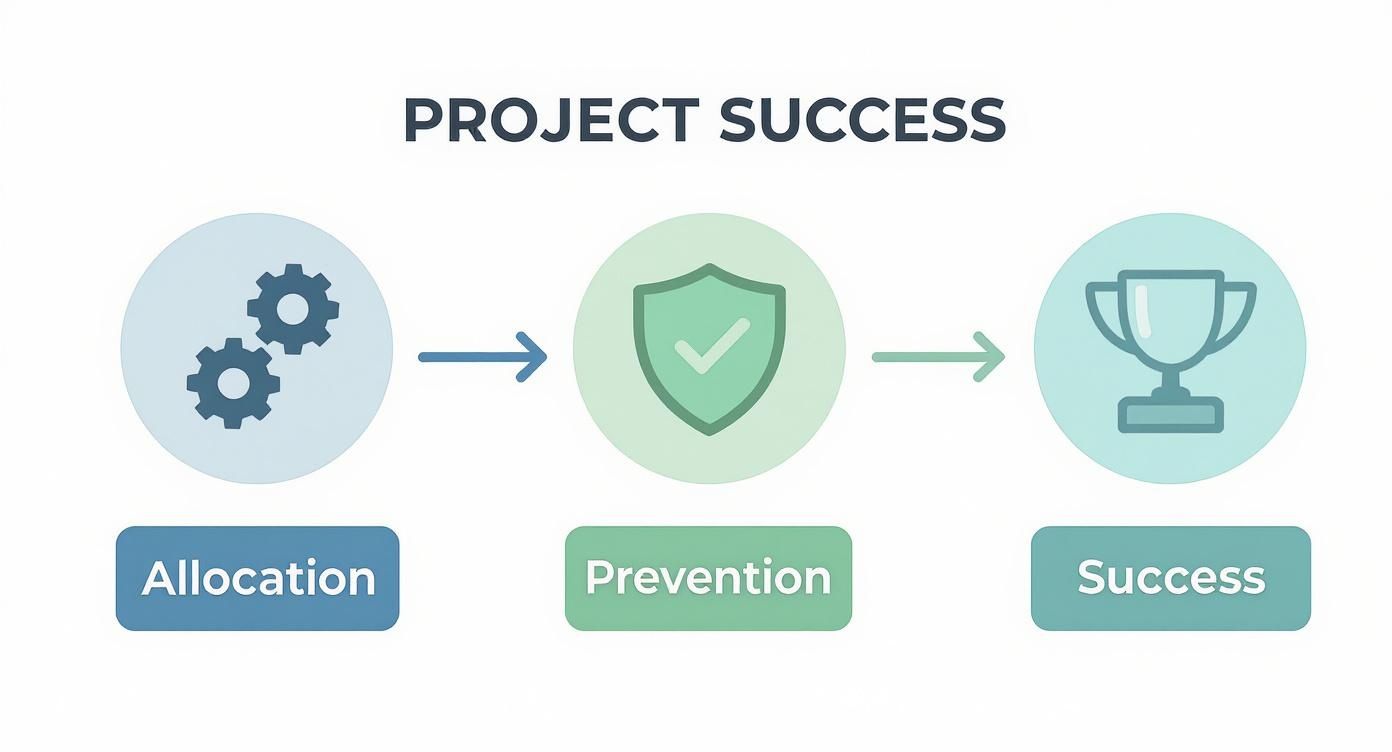
The key insight here is that allocation isn't just an administrative chore; it's a proactive step that directly shapes your project's health and final outcome.
Step 5: Track and Adapt Continuously
Finally, no resource allocation plan ever survives contact with reality completely intact. Projects are dynamic, things change, and your plan has to be able to change, too. Once the work starts, your job shifts to monitoring progress, tracking how resources are being used, and making adjustments on the fly.
Continuous tracking lets you spot potential problems early. Is a task taking longer than you thought? Is one team member consistently overloaded? By keeping a close eye on your plan versus reality, you can reallocate resources, shift timelines, or let stakeholders know about delays before they become full-blown crises. This agile approach is what separates managers who stick to a failing plan from those who guide their projects to success.
Choosing the Right Allocation Technique
Think of resource allocation like a chef picking the right cooking method. You wouldn't sous-vide a steak if you needed it done in five minutes, and you wouldn't pan-sear a tough cut of meat that needs hours to break down. The same logic applies here. The right technique depends entirely on your project's ingredients - its deadlines, constraints, and the people involved.
Applying a one-size-fits-all strategy is a recipe for disaster. To get this right, you need to understand the fundamental approaches to resource allocation in project management. Each one solves a different, common problem, from keeping your team from burning out to hitting an unmovable deadline. Let's break down the most effective methods and when you should use them.
Resource Leveling for a Sustainable Pace
Ever seen what happens on a highway when three lanes merge into one during rush hour? It’s a complete standstill - a traffic jam of frustration and missed appointments. That’s exactly what happens when one of your team members is over-allocated. Work piles up, creating a bottleneck that brings the entire project to a screeching halt.
Resource leveling is your traffic control system. It fixes over-allocation by being flexible with the project timeline. If someone is drowning in tasks, this method finds non-critical work on their plate and pushes the deadlines out to give them breathing room.
The main goal here is to keep a steady, sustainable pace and avoid burning out your team. Yes, it often means the project's final end date might get pushed back. But the trade-off is a happier, healthier team that produces much higher-quality work. This is the perfect approach when your team’s well-being is more important than a rigid deadline.
Resource Smoothing for Fixed Deadlines
But what if that deadline is set in stone? What if you absolutely, positively cannot push the delivery date? That's where resource smoothing comes in. Think of it like organizing a pantry with limited shelf space. You can't make the pantry bigger, but you can definitely rearrange the jars and boxes to make everything fit without crushing the bread.
Resource smoothing operates within your fixed project timeline. It takes advantage of any "float" or "slack" in the schedule - that little bit of wiggle room some tasks have before they start impacting other dependent tasks. The idea is to shift work around to even out the peaks and valleys in someone's workload, all without touching the final deadline.
This is a much gentler approach focused on making the most of the time you have. It’s perfect for projects where hitting the deadline is the top priority, but you still want to protect your team from those crazy periods of high stress followed by lulls with nothing to do.
For instance, if your graphic designer is slammed in week three but has a light schedule in week four, you can move a lower-priority design task from the third week to the fourth. The project still finishes on time, but you’ve just saved your designer from a whole lot of stress.
Critical Path Method for Prioritizing What Matters
Let’s be honest: not all tasks are created equal. Some are so fundamental that a delay of even one day will throw the entire project off schedule. The Critical Path Method (CPM) is a brilliant technique for finding this make-or-break sequence of tasks.
Picture your project as a long line of dominoes. The critical path is the longest string of dominoes that must fall in perfect order to knock over the final one. If a single domino in that line is late, the whole chain reaction stops. CPM helps you identify that exact sequence so you know where to focus.
Once you’ve mapped out your critical path, you can assign your most skilled and reliable people to those high-stakes tasks. It forces you to be ruthless with your priorities, making it crystal clear where your attention and resources will have the biggest impact. It's a must-have for complex projects with a web of dependent tasks where every day counts.
Comparing Resource Allocation Techniques
To make it even clearer, here’s a quick look at how these three techniques stack up against each other. Each has its place, and knowing the difference is key to making the right call.
| Technique | Primary Goal | Impact on Project Deadline | Best For |
|---|---|---|---|
| Resource Leveling | Resolve over-allocation and prevent burnout. | May extend the deadline. | Projects where team well-being and quality are the top priority. |
| Resource Smoothing | Balance workloads within existing timeframes. | Does not change the deadline. | Projects with firm deadlines that still need workload balancing. |
| Critical Path Method | Identify and prioritize the most crucial tasks. | Focuses on protecting the deadline. | Complex projects with many dependent tasks and tight schedules. |
Ultimately, choosing the right technique is a strategic move. By mastering these core methods, you can go from just assigning tasks to making smart, informed decisions that set your projects and your team up for success from day one.
Sidestepping Common Resource Allocation Traps
In project management, knowing what not to do is just as important as having the perfect plan. Even the best strategies can get tripped up by predictable pitfalls. Getting resource allocation right means learning to spot these traps from a mile away and steering your team clear.
These issues rarely announce themselves. They usually start as small, seemingly harmless decisions that eventually snowball into project-killing problems. By understanding them now, you can build a stronger, more resilient strategy.
The Pitfall of Unrealistic Planning
This is probably the most common trap of all: creating a plan that looks flawless on paper but falls apart the moment it hits the real world. This is what happens when you forget that resources are people, not just numbers in a spreadsheet.
An unrealistic plan doesn't account for the human side of work - things like vacations, sick days, or sudden personal appointments. It also ignores all the non-project tasks that eat up time, like team meetings, admin work, or training. When you book your team at 100% capacity, you leave zero room for reality to happen. This is a fast track to burnout, missed deadlines, and a nosedive in quality as everyone struggles to stay afloat.
The goal isn’t to maximize busyness; it's to optimize for sustainable productivity. A schedule that respects the human element is a schedule built to last.
The Danger of Overallocation
Here's another classic mistake: piling all the toughest tasks onto your top performers. It feels smart - give the most important work to your best people, right? But relying on the same few individuals is a recipe for disaster. It not only burns out your star players but also robs the rest of the team of chances to grow and learn.
Over time, this creates a massive risk. If that one key person gets sick or decides to leave, your whole project can come to a screeching halt. A much better approach is to balance the workload, distributing critical tasks to build a more skilled and resilient team.
The Chaos of Poor Resource Visibility
You can’t manage what you can’t see. A huge hurdle for many managers is the lack of a clear, single view of who is doing what and when they’re available. When this information is scattered across messy spreadsheets, email chains, and different calendars, you're practically inviting chaos to the party.
Without a single source of truth, you get double-bookings, conflicting priorities, and decisions made in the dark. This is a widespread problem. One study found that 41% of resource managers struggle with just getting a clear line of sight into their teams. In fact, 27% of organizations say capacity planning is their biggest resource management challenge. Getting this right is huge - effective management can cut wasted project spending in half, a topic explored in these resource allocation insights from Invensis Learning.
Ignoring the Silent Killer: Scope Creep
Scope creep is the quiet assassin of projects. It starts with a simple "small favor" or a "quick addition" that wasn't part of the original plan. Before you know it, these little extras pile up, demanding more time and resources than you ever budgeted for.
Without a formal change request process, your perfectly balanced allocation plan becomes useless. The fix? You need a rock-solid scope management process. Every new request has to be officially reviewed to see how it impacts the timeline, budget, and team workload before it gets the green light. This discipline is what turns "scope creep" into "scope control." When you're trying to keep several projects on track, a strong strategy is non-negotiable. Learn more in our guide on how to manage multiple projects.
How Widgetly Takes the Headache Out of Resource Management
All the frameworks and theories in the world won't help you much if your tools aren't up to the task. You simply can't manage what you can't see. This is where the rubber meets the road - where resource allocation in project management moves from a nice idea to a daily reality. And it’s exactly where Widgetly comes in to take the guesswork out of the equation.
Widgetly pulls your resource planning out of static spreadsheets and turns it into a living, breathing command center. It gives you the clear, real-time visibility that most managers are missing, translating a jumble of data into insights you can actually use to stop problems before they even start.
Get a Clear Picture with Real-Time Dashboards
Tired of asking, "Who's working on what?" Those days are over. Widgetly gives you a single screen where you can see your entire team’s workload, who’s available, and how projects are tracking. Getting that instant clarity is the first step toward managing proactively, letting you spot a potential bottleneck or an overbooked team member at a glance.
This is a pretty standard view in Widgetly, showing team capacity against project timelines.
What's powerful here is how quickly you can tell the design team is swamped, but the developers have some bandwidth opening up next week. That makes reassigning a few tasks a smooth, obvious decision. To see what else is possible, check out our guide on project management dashboard templates.
Master Your Team's Capacity and Stop Burnout in its Tracks
One of the trickiest parts of resource management is hitting that sweet spot - the 80% utilization rate that keeps people challenged but not overwhelmed. Widgetly's capacity planning tools make this surprisingly simple. You can see everyone's workload and even get alerts when someone is getting close to their limit.
When you can actually see capacity, you can make smarter decisions to protect your most important asset: your people. It's about keeping workloads fair and sustainable, which is the secret to high-quality work.
This is how you avoid the classic mistake of piling all the work on your top performers. Instead of just guessing, you have real data showing who has room for more and who might need a hand. The result is a healthier, more motivated team that can deliver consistently without hitting a wall.
And with straightforward reporting, you can keep an eye on your budgets and timelines with that same level of clarity. It lets you connect your resource decisions directly to the financial health of your projects, making sure you stay on schedule and in the black. Widgetly gives you the tools you need to put all that great theory into practice, every single day.
Got Questions About Resource Allocation? We've Got Answers.
Diving into resource allocation often brings up a few common questions. It's totally normal. Getting a handle on these concepts is the first step to confidently steering your projects and making smarter decisions for your team. Let's clear up some of the most frequent ones.
What's the Real Difference Between Resource Allocation and Resource Management?
This is a great question, and it's easy to get them mixed up. Think of it like a coach and a playbook.
Resource management is the entire playbook. It’s the big-picture strategy that covers everything from forecasting your needs for the next quarter to planning your team's capacity and overseeing all your assets - people, money, and tools - across the whole company. It’s the ongoing, strategic game plan.
Resource allocation, on the other hand, is a specific play you call on the field. It’s the tactical, day-to-day action of assigning a specific person, a piece of equipment, or part of the budget to a particular task for a defined time. You simply can't win the game (effective management) without executing the right plays (smart allocation).
How Do You Deal With Resource Conflicts Between Projects?
Ah, the classic project management headache. This happens all the time, especially when your best people are in high demand. The first step is to get everything out in the open. You need a single, shared view where everyone can see all projects and who’s working on what.
Once you have that bird's-eye view, you have to prioritize. Let's be honest, not all projects are created equal. You need to rank them based on what’s most critical to the business right now.
With a clear priority list, you can get your project managers talking. Often, a simple conversation and a small tweak to one project's timeline can solve a major bottleneck for another. If a friendly negotiation doesn't work, it's time for a leadership decision - either a deadline gets pushed, or you find a way to bring in more help.
What's a Realistic Resource Utilization Rate to Aim For?
It’s tempting to shoot for 100% utilization, but in my experience, that's a direct path to burnout and sloppy work. The number you'll hear from most seasoned managers is 80%. That’s the sweet spot.
Why not max everyone out? That extra 20% isn't dead time; it's a vital buffer. It gives your team breathing room for all the essential, non-project work that actually keeps the wheels turning:
- Answering emails and attending internal meetings
- Putting out unexpected fires or handling last-minute requests
- Training, learning, and just having a moment to think creatively
Trying to keep a team running above that 80% mark for too long is a recipe for disaster. Morale plummets, mistakes creep in, and you end up with an exhausted team that can't roll with the punches.