
What Is Capacity Planning for Modern Business
Think of capacity planning as the process of making sure your business has just the right amount of everything it needs - people, equipment, technology - to meet customer demand. It’s all about having exactly what you need, right when you need it. This way, you avoid wasting money on things you don't use or, even worse, frustrating customers because you can't keep up.
Defining Your Business Blueprint
Let's say you're throwing a huge dinner party. You wouldn't just start cooking without knowing how many people are coming, right? You'd first figure out your guest count and then plan the menu. This simple foresight stops you from having hungry guests or a fridge overflowing with leftovers.
Capacity planning is that same idea, just applied to a business. It’s the critical discipline of matching what your company can do with what your customers want to buy.
This goes way beyond just a headcount of employees or a tally of servers. It’s about creating a perfectly balanced system. The sweet spot is operating smoothly without hitting one of two major roadblocks:
- Under-capacity: This is the classic "too much demand, not enough supply" problem. Imagine an e-commerce site crashing during a huge Black Friday sale. That’s a direct hit to revenue and a big blow to customer trust.
- Over-capacity: Here, your resources far outweigh demand. Picture a company paying a fortune for a massive office that's mostly empty or for powerful servers that just sit there doing nothing. It's a quiet but constant drain on your profits.
To give you a clearer picture, let's break down the core components involved.
Key Elements of Capacity Planning at a Glance
| Component | Description | Example |
|---|---|---|
| Demand Forecasting | Predicting future customer demand for your products or services based on historical data and market trends. | A retail store analyzing past holiday sales to predict how many seasonal staff they'll need this year. |
| Resource Analysis | Evaluating your current resources (staff, technology, equipment) to understand their maximum output. | A software company measuring its current server load to determine how many more users it can support. |
| Performance Monitoring | Continuously tracking how well your resources are performing against established benchmarks. | A call center tracking average wait times to see if they need more agents on shift. |
| Gap Analysis | Comparing your forecasted demand with your current resource capacity to identify potential shortfalls or surpluses. | A manufacturer realizing their current production line can't meet the projected demand for a new product. |
Ultimately, these elements work together to help you make smarter, more proactive decisions.
The Core Goal of Capacity Planning
The real goal here is to find that perfect equilibrium between what you spend and the quality of service you deliver. It helps you answer the big strategic questions: How many support agents do we really need for the holiday rush? Can our cloud setup handle a massive product launch? When is the right time to buy that new piece of manufacturing equipment?
At its heart, capacity planning transforms reactive problem-solving into proactive strategy. It allows a business to confidently navigate future demand instead of being caught off guard by it.
While capacity planning has long been a staple in IT and manufacturing, its importance has skyrocketed everywhere. The global market for capacity management was once valued at USD 597.5 million and was projected to jump to USD 1.55 billion in just a few years. That growth, highlighted in reports about capacity management strategies on marketsandmarkets.com, is fueled by a universal need to get the most out of every resource.
By truly understanding what capacity planning is, you give your organization a blueprint for sustainable growth, smart cost management, and happy customers.
Why Capacity Planning Is Your Business Superpower
We've talked about what capacity planning is, but the real magic happens when you understand why it's so crucial. This is where you shift from just reacting to problems to actively getting ahead of them. Without a solid plan, you're basically flying blind and hoping for the best - a risky way to run a business.

Think about an e-commerce site on Black Friday. If they underestimate the traffic and their website crashes, sales disappear in an instant. So does customer trust. That's a classic, and very expensive, example of under-planning.
On the other hand, imagine a new startup leasing a massive office, expecting explosive growth that never quite arrives. Now they're stuck paying for empty desks and bleeding cash. This is a clear case of over-planning. Both mistakes hit the bottom line hard.
From Cost Center to Strategic Advantage
When you get capacity planning right, it stops being a source of surprise expenses and becomes a solid platform for growth. It’s not just about dodging bullets; it’s about making smarter, more confident decisions across the board.
By accurately predicting what you’ll need, you can:
- Optimize Your Budget: You stop wasting money on unused software licenses, idle equipment, or staff with nothing to do. Every dollar is put to good use.
- Improve Customer Experience: Consistently meeting demand means you're reliable. Reliability builds a strong reputation and keeps customers coming back.
- Enable Sustainable Growth: You can scale up smoothly, adding resources just as you need them to seize new opportunities without skipping a beat.
This kind of strategic thinking is more important than ever. The global market for capacity management solutions was valued at USD 1.74 billion and is expected to jump to USD 2.17 billion the next year. That's a massive 24.9% growth rate, showing just how seriously businesses are taking this. You can see more details in reports on the capacity management market from The Business Research Company.
Capacity planning is the strategic act of ensuring your business is always prepared for what's next, turning potential chaos into controlled, predictable success.
Ultimately, getting this right is like having a business superpower. It allows you to run efficiently, serve your customers without a hitch, and grab growth opportunities with both hands, keeping you well ahead of the competition. It’s the foundation of any resilient, profitable company.
Understanding the Building Blocks of Your Capacity Plan
A solid capacity plan isn't a single, monolithic document. It's built from three core components that work together. Think of it like building a bridge: you need to know how much traffic it has to handle (demand), the strength of your materials (resources), and whether those materials can actually support that traffic (the gap). Get any part wrong, and you're headed for trouble.
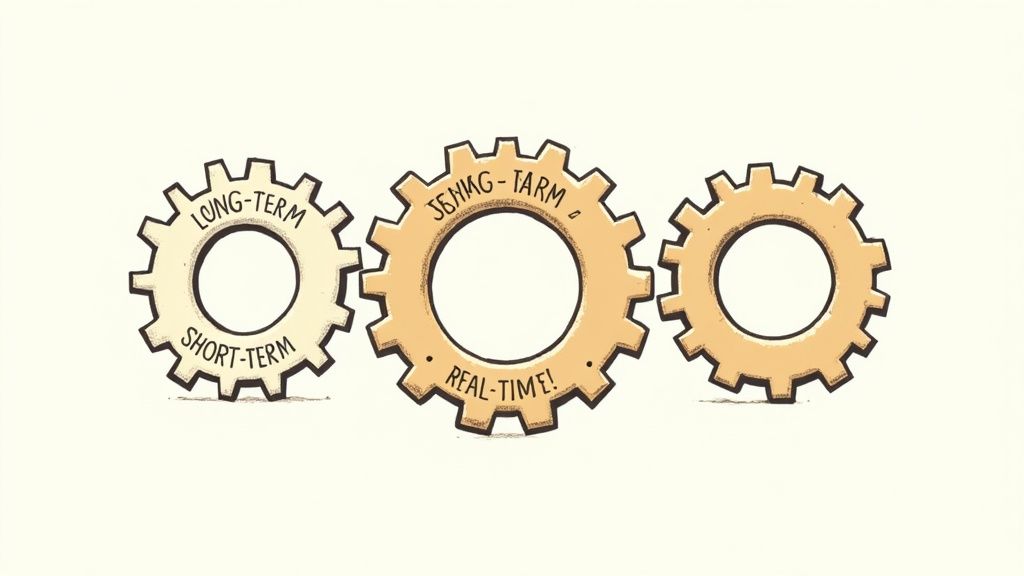
This structured approach takes the guesswork out of planning. It turns a complex challenge into a series of manageable steps. Each component gives you a critical piece of the puzzle, creating a clear picture of where you are today and where you need to be tomorrow.
Let's break down these foundational pieces.
Demand Forecasting: Predicting Future Needs
First up is demand forecasting. This is all about anticipating what your customers are going to need from you down the road. It isn't about gazing into a crystal ball; it's a data-driven process that digs into past trends and market signals to make an educated guess about the future.
A retailer, for example, will look at last year’s holiday sales data to figure out how much inventory to order for the upcoming season. In the same way, a software company might analyze user growth rates to predict how much server power they'll need next quarter. The whole point is to see demand spikes and lulls coming before they arrive.
Resource Analysis: Knowing What You Have
Once you have a handle on future demand, it’s time for resource analysis. This means taking a detailed inventory of your current capabilities. You need to know exactly what your people, technology, and equipment can handle right now.
This is where you measure everything that impacts your ability to deliver.
- Technology: How many users can your servers support before performance starts to lag?
- People: What’s the maximum number of tickets your support team can realistically close in a day?
- Equipment: How many units can your manufacturing line produce per hour at full tilt?
Understanding these limits is non-negotiable. It's also a good time to figure out how to measure team productivity to get an honest assessment of your human resources. This internal audit provides the firm baseline you'll build everything else on.
Gap Analysis: Connecting Demand and Resources
Finally, gap analysis brings the first two pieces together. It’s a straightforward comparison of your forecasted demand against your current resource capacity, pinpointing any mismatch. This is where you find the "gap" between what you'll need and what you actually have.
Gap analysis answers the most important question in capacity planning: "Are we prepared for what's coming?" It transforms raw data into a clear, actionable insight.
If your forecast shows you’ll need to handle 5,000 support tickets a day but your team can only manage 3,500, you have a capacity gap of 1,500 tickets. Identifying this shortfall is the crucial first step. It allows you to build a concrete plan to close that gap, whether that means hiring more staff, adopting better tools, or simply improving your processes.
Choosing Your Capacity Planning Strategy
Once you have a handle on what future demand looks like and what your team can currently manage, you hit a critical fork in the road. How, exactly, do you bridge the gap between where you are and where you need to be?
There's no single right answer here. The best strategy really comes down to your company's personality - your business model, how much cash you have on hand, and your appetite for risk. Picking the wrong approach can be just as damaging as having no plan at all.
You're essentially choosing from three main playbooks: Lead, Lag, and Match. Each one strikes a different balance between investing ahead of time and waiting to react, and your choice will directly affect both your bottom line and how happy your customers are.
The Lead Strategy: Get Ahead of the Game
The Lead strategy is all about adding capacity before you see the demand hit. Think of a popular toy company ramping up production in July for the holiday rush. They’re making a calculated bet that the season will be a big one, and they want to be ready to meet every bit of that demand without a hitch.
This is an aggressive, proactive approach. It ensures you’re never caught flat-footed, scrambling to fulfill orders or turning away business. The obvious risk? If that predicted demand doesn't show up, you're stuck with excess inventory or idle staff, which can be a serious financial burden.
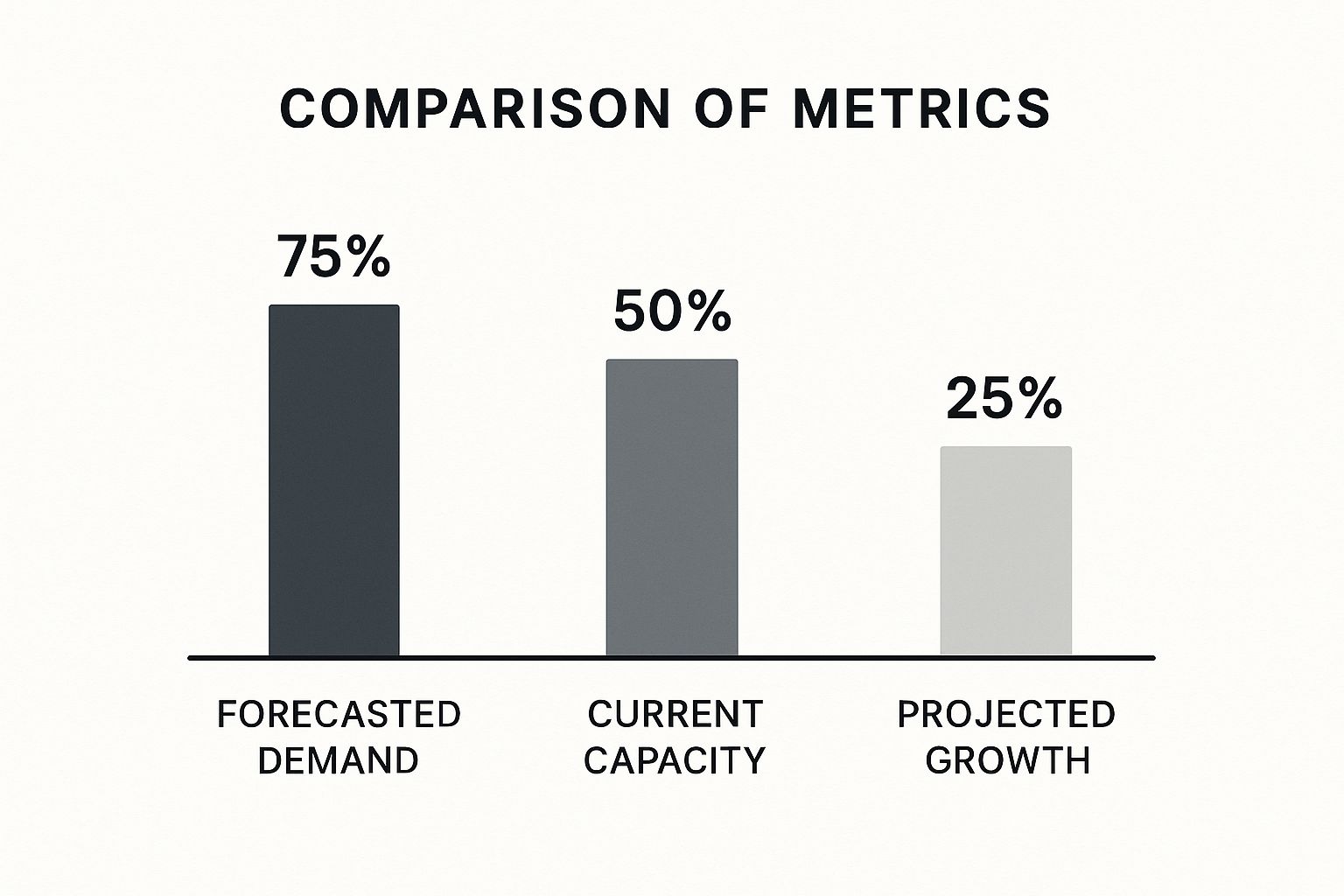
The chart above shows a common scenario where projected growth outpaces current capacity, signaling that it's time to make a strategic decision.
The Lag Strategy: Wait and See
On the complete opposite end of the spectrum is the Lag strategy. This is a much more cautious, reactive game plan. You only add more resources after demand has clearly and consistently outstripped your ability to keep up.
Imagine a local bakery that only hires a second baker after there's a line out the door every single morning. This approach is financially safe - you know for a fact that every dollar you spend on expansion is backed by real, proven demand. The trade-off, however, is the customer experience. You risk long waits, sold-out products, and frustrated customers who might just go to the competitor down the street.
Capacity planning comes down to a fundamental choice: Would you rather risk wasted investment (Lead) or risk lost customers (Lag)? Your answer says a lot about which strategy fits your business.
The Match Strategy: Find the Middle Ground
The Match strategy aims to be the "just right" option, sitting squarely between the other two. Here, you add capacity in smaller, more frequent increments that closely follow the rising tide of demand.
A great example is an e-commerce site that adds a little more server power each month as its user base grows, rather than making one massive, expensive upgrade. This balanced approach helps you avoid the major pitfalls of having way too much or far too little capacity. It can be more hands-on to manage, but it often provides the most efficient use of resources. For tips on managing these incremental changes, check out our guide on what is workflow automation.
To make the choice clearer, let's break down how these three strategies stack up against each other.
Comparison of Capacity Planning Strategies
This table lays out the core differences between the Lead, Lag, and Match strategies, helping you decide which one aligns best with your business goals and operational style.
| Strategy | Description | Pros | Cons | Best For |
|---|---|---|---|---|
| Lead | Adding capacity in anticipation of future demand. | - Always ready for customers- Can gain market share- High customer satisfaction | - Risk of underutilized resources- Higher upfront investment | Growth-focused businesses in competitive markets. |
| Lag | Adding capacity only after demand exceeds current capacity. | - Low financial risk- No wasted investment- Investment is justified by proven demand | - Risk of losing customers- Poor customer experience (long waits, stockouts)- Can fall behind competitors | Businesses with tight budgets or in stable, predictable markets. |
| Match | Adding capacity in small increments as demand grows. | - Balances risk and opportunity- Highly flexible- Efficient use of resources | - Can be complex to manage- Requires constant monitoring | Businesses in dynamic markets with unpredictable demand. |
Ultimately, the best strategy is the one that lets you sleep at night. Whether you're an ambitious risk-taker, a cautious planner, or someone who prefers to stay flexible, there’s an approach that fits.
Putting Your Capacity Plan Into Action
You've done the hard work and built a solid capacity plan. That's a great start, but a plan on paper is just that - paper. Its real power is unlocked when you put it into motion, and that requires a coordinated effort, the right tools, and a commitment to seeing it as an ongoing cycle, not a one-and-done project.
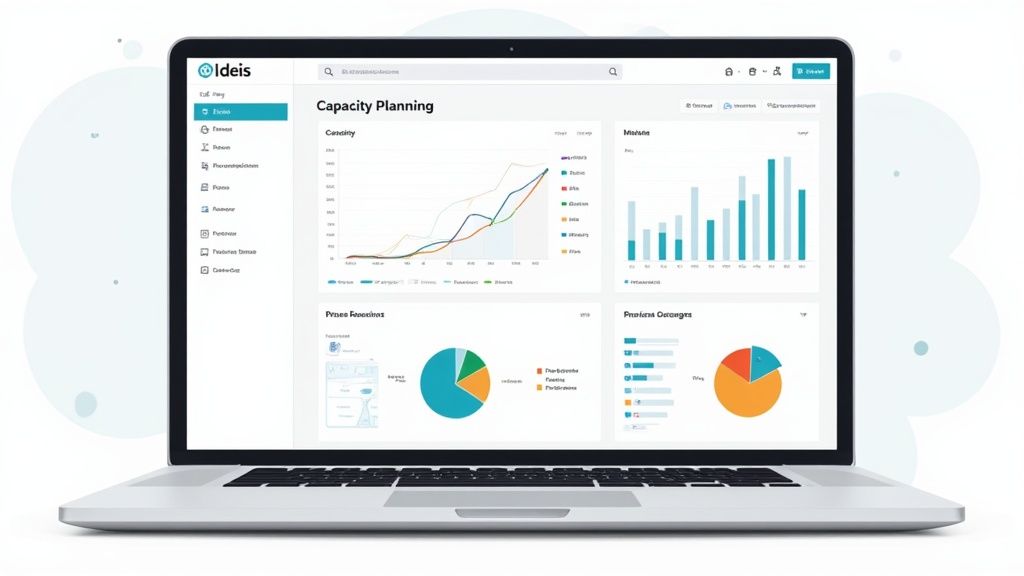
The first step is getting everyone on the same page. Your capacity plan isn't just an IT document or an operations checklist; it's a strategic guide for the entire business. Success depends on tight alignment between your tech, finance, and operational teams, all pulling in the same direction to boost efficiency and keep customers happy.
Assembling Your Toolkit
With your teams aligned, it's time to choose the tools you'll use to monitor capacity. The idea is to track real-world performance against your forecasts, so you can catch small deviations before they snowball into major issues.
For some, a well-organized spreadsheet might do the trick, at least initially. But as your operations grow more complex, you'll likely need something more robust. This could mean specialized capacity management software or performance monitoring platforms that provide automated alerts and deep analytics. This is especially true in competitive markets like North America, where spending on capacity management is projected to jump from USD 579 million to USD 2.81 billion as businesses adopt more advanced tools. You can read more in this capacity management market analysis from Consegic Business Intelligence.
The Cycle of Monitor, Learn, and Adjust
It's tempting to think of capacity planning as a task you can check off your list, but that's a mistake. It’s a living process that needs constant attention. Markets shift, customer demands evolve, and new technologies change the game. Your plan has to be nimble enough to keep up.
This creates a simple but powerful feedback loop:
- Monitor: Keep a close eye on your key performance indicators (KPIs). How do they stack up against your forecasts?
- Learn: Dig into the gaps between your predictions and what actually happened. What caused that unexpected demand spike? Why is one resource consistently underperforming?
- Adjust: Use what you've learned to fine-tune your forecasts, shift resources, and update your overall strategy.
Think of your capacity plan like a ship's navigational chart. You wouldn't plot a course and then tuck the map away. You’d constantly check your position, adjust for changing currents, and correct your heading to stay on track.
Starting Small to Win Big
If you're rolling out a major capacity plan for the first time, it can feel like a massive undertaking. The best way to tackle it is to start small with a pilot project. Pick a single department or one specific service to test your new process.
This gives you a low-risk sandbox to iron out the wrinkles, make sure your tools work as expected, and build your team's confidence. The lessons you learn from a small-scale pilot are gold, paving the way for a much smoother and more successful rollout across the rest of the company. Managing an initiative like this is a project in itself, and you can brush up on the essentials in our guide to project management for beginners.
Common Questions About Capacity Planning
https://www.youtube.com/embed/EkfR8qbWpU0
Even after you get the hang of the basics, putting capacity planning into practice brings up a whole new set of questions. It’s not just about crunching numbers; it’s about making smart judgment calls and staying flexible as things change.
Let’s tackle some of the most common questions that pop up. My goal is to clear up any confusion so you can feel confident managing your resources.
How Often Should We Review Our Capacity Plan?
This is a big one. It’s tempting to create a plan and file it away, but that’s a recipe for disaster. Think of it as a living document, not a static report.
How often you review it really depends on how fast your world is moving. A high-growth startup might need to look at its plan every month. A more stable, established business could probably stick to a quarterly review.
For most companies, a formal review at least once per quarter is a solid rule of thumb. It keeps you on your toes without getting bogged down in endless meetings.
But scheduled check-ins aren't the only time to dust off the plan. You should revisit it immediately after any major business event, such as:
- Launching a new product that could spike demand.
- Expanding into a new market with a whole new customer base.
- A major tech upgrade that changes what your resources can handle.
- Sudden market shifts, like a new competitor emerging or customer tastes changing.
The goal isn't to constantly rewrite the plan, but to make sure it always reflects reality.
What Is the Difference Between Capacity Planning and Resource Scheduling?
This question trips up a lot of people, but the difference is pretty simple once you see it. It all comes down to timing and perspective.
Capacity planning is the long-term, strategic view. It answers the big question: "Do we have enough people, equipment, and technology to handle what's coming over the next year or two?" It's about making high-level decisions, like hiring 10 new engineers or investing in a new data center.
Resource scheduling, on the other hand, is tactical and immediate. It’s about the here and now, answering the question: "Who is doing what this week?" It’s the day-to-day work of assigning specific people to specific tasks to hit deadlines.
Think of it this way: capacity planning builds the stadium, while resource scheduling assigns players to their positions for the game.
What Tools Are Best for Capacity Planning?
There’s no magic-bullet answer here - the best tool is the one that fits your company’s size and complexity. Your options usually fall into one of three buckets.
-
Spreadsheets (Excel, Google Sheets) Don’t underestimate the humble spreadsheet! For a small team just getting started, a well-built spreadsheet is a fantastic, low-cost way to track basic demand and resources. The downside? They can get messy and hard to manage as you grow.
-
Project Management Software (Asana, Trello, Jira) Many of the project management tools you're likely already using have features for tracking team workloads. They're great for seeing who's busy and who has room for more, which makes them perfect for the resource scheduling side of things.
-
Specialized Capacity Management Software When you get to a certain size, you need more firepower. Dedicated capacity planning tools are built for complex organizations. They offer advanced forecasting, real-time dashboards, and the ability to run "what-if" scenarios. This is the kind of software that helps you see around corners and stay ahead of demand at scale.
The trick is to start with what you need right now. Don’t over-engineer it. You can always upgrade your toolkit as your business gets more complex.